Crawl Space Encapsulation Longs, SC
Longs occupies a transitional soil zone in northwestern Horry County where the highly permeable sandy coastal plain soils of the beachside Grand Strand grade into slightly heavier mixed soils with modestly higher clay content. This transitional profile means that Longs properties do not experience the extreme barrier island water table dynamics of the oceanfront communities, but neither do they have the clay soil hydrostatic pressure issues characteristic of Conway and the inland Pee Dee region. What they do experience is the same marine humidity influence that drives condensation across the entire Grand Strand — the atmospheric moisture load of the Myrtle Beach area extends well inland from the immediate coast, reaching the Longs area with only modest attenuation.
Schedule a Free Crawl Space Inspection
Call (843) 585-3994 or send a quick note below.
Why Longs, SC Crawl Spaces Struggle With Moisture
The development pattern in Longs skews toward newer construction compared to the established beach communities, but newer construction does not necessarily mean compliant crawl space systems. Many homes built in Longs subdivisions during the rapid growth period of the 2000s and 2010s were constructed with vented crawl spaces that met the code requirements of the time but are not the sealed, conditioned approach that SC R408.3 now allows. Many were finished with basic 6-mil vapor barriers and standard foundation vents, which can struggle as Grand Strand humidity cycles take their toll.
What Crawl Space Inspections in Longs Often Turn Up
Longs is an unincorporated community in northern Horry County along SC 9, near the North Carolina line and the Waccamaw River. New subdivisions have spread along SC 9 and SC 905, while low areas near the river flooded during Hurricanes Matthew and Florence. Inspections in newer homes commonly find builder plastic with gaps and sweating ductwork, while homes on lower ground near the river may show water lines, wet insulation, and blocked flood openings. Permits go through Horry County.
Signs of a Crawl Space Moisture Problem
- Musty odors in the living area, often strongest near floor vents.
- Cupping hardwood floors, where board edges curl upward from moisture below.
- Sweating ductwork dripping onto insulation that sags or falls.
- White or gray growth on joists or insulation backing. Learn about crawl space mold.
- A sticky house even while the air conditioner runs.
Crawl Space Services in Longs
Every visit starts with what the crawl space is actually showing: moisture readings, standing water, and the condition of the vapor barrier, insulation, and ductwork. Each service below links to a page explaining what the work involves, and the full services overview shows how they fit together. Electrical, plumbing, and pest work is referred to licensed professionals.
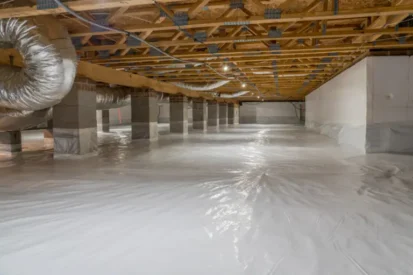
Crawl Space Encapsulation
Newer Longs homes often need the builder’s barrier sealed and the space conditioned, while homes on lower ground near the Waccamaw need flood-zone planning first.
Vapor Barrier Installation
Builder plastic with gaps is common in subdivisions along SC 9 and SC 905. A continuous, sealed barrier carried up the walls closes them.
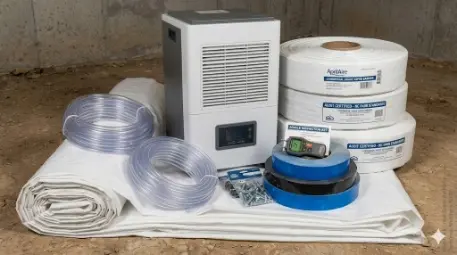

Crawl Space Dehumidification
Sweating ductwork in newer Longs homes usually means the crawl space needs conditioning. A dehumidifier sized to the space is the common choice.
Crawl Space Insulation
Wet insulation is common in homes on lower ground that saw past flooding. It comes out so the framing can be checked and dried.
Crawl Space Mold Remediation
Homes near the river that took on water can show growth on framing. Remediation and moisture control are handled together.
Frequently Asked Questions
Is crawl space encapsulation required by SC building code?
No. Under the 2021 South Carolina Residential Code, a vented crawl space is still allowed. Section R408.3 adds the option of a sealed crawl space when the ground is covered with a continuous Class I vapor retarder, seams overlap at least 6 inches and are sealed, the edges run at least 6 inches up the stem wall, and the space is conditioned, for example with a dehumidifier sized at 70 pints per day per 1,000 square feet. Homes in flood zones also need their required flood openings kept working.
How much does crawl space encapsulation cost in Longs, SC?
In Longs, scope depends on whether the home is newer construction or on lower ground near the river, flood zone requirements, how much material needs replacing, and the crawl space’s size. A free inspection gives you an accurate price.
Does encapsulation add value to a home in Longs?
Longs has seen a lot of new construction, and buyers’ inspectors commonly check crawl spaces even in newer homes. A dry, documented crawl space may be one less item to negotiate, though the effect varies.
Longs
Request a Free Inspection or Call (843) 585-3994
Not in Longs? See the other Grand Strand communities we serve.