Crawl Space Encapsulation Socastee, SC
Socastee’s crawl space moisture profile is shaped by its position in the southern Horry County coastal plain, where the combination of Intracoastal Waterway proximity and the age of the predominant housing stock creates a consistent pattern of sub-floor moisture accumulation. The community’s older residential areas — developed primarily in the 1960s through 1980s — were built when the scientific understanding of crawl space moisture dynamics in humid coastal climates was fundamentally different from current building science. The foundational assumption of that era was that ventilating a crawl space with outdoor air would prevent moisture buildup. Decades of research in humid subtropical climates like the Grand Strand have demonstrated the opposite: in summer conditions, outdoor air ventilation actively introduces more moisture than it removes.
Schedule a Free Crawl Space Inspection
Call (843) 585-3994 or send a quick note below.
Why Socastee, SC Crawl Spaces Struggle With Moisture
The practical consequence in Socastee’s older neighborhoods is housing stock with crawl spaces that have been on the wrong side of moisture management for 40 to 60 years. Wood framing members in these crawl spaces have experienced repeated wet-dry cycling that affects structural integrity over time. Fiberglass batt insulation — where it remains in place — has typically absorbed sufficient moisture over decades to lose most of its thermal resistance value and in many cases has become a substrate for mold colonization along the paper backing. Properties near Socastee’s Intracoastal Waterway frontage carry the additional consideration of potential FEMA flood zone designations that must be assessed before a sealed crawl space system is designed.
What Crawl Space Inspections in Socastee Often Turn Up
Socastee sits along the Intracoastal Waterway south of Myrtle Beach, home to the historic Socastee Swing Bridge, and parts of the community flooded when the Waterway backed up after Hurricane Florence in 2018. Homes near the Waterway and its creeks can carry FEMA flood zone requirements, while older neighborhoods farther inland date from the 1960s through 1980s. Inspections often find water lines on foundation walls, insulation that never fully dried after past high water, and flood openings blocked by debris or covered over. Because Socastee is unincorporated, permits go through Horry County.
Signs of a Crawl Space Moisture Problem
- Musty odors in the living area, often strongest near floor vents.
- Cupping hardwood floors, where board edges curl upward from moisture below.
- Sweating ductwork dripping onto insulation that sags or falls.
- White or gray growth on joists or insulation backing. Learn about crawl space mold.
- A sticky house even while the air conditioner runs.
Crawl Space Services in Socastee
Every visit starts with what the crawl space is actually showing: moisture readings, standing water, and the condition of the vapor barrier, insulation, and ductwork. Each service below links to a page explaining what the work involves, and the full services overview shows how they fit together. Electrical, plumbing, and pest work is referred to licensed professionals.
Crawl Space Encapsulation
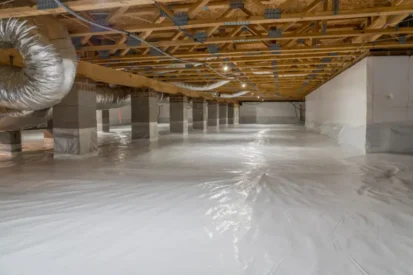
Many Socastee homes near the Waterway sit in flood zones, so a sealed design has to keep flood openings working, often with engineered flood vents. Inland homes from the 1960s through 1980s usually start with sealing old vents.
Vapor Barrier Installation
Homes that saw high water need a barrier that can be inspected and replaced if water returns. A continuous, taped liner carried up the walls is the standard approach.

Crawl Space Dehumidification
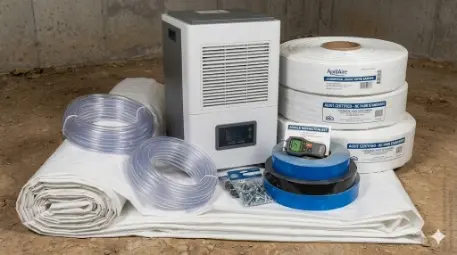
After a wet season along the Waterway, a sealed Socastee crawl space needs conditioning to dry out and stay dry. A dehumidifier sized to the space is the common choice.
Crawl Space Insulation
Insulation that got wet in past floods often never fully dries. It is removed so the framing can dry and be checked before anything new goes in.
Crawl Space Mold Remediation
Framing that dried slowly after past flooding can show growth. Remediation treats it, and moisture control helps keep it from returning.
Frequently Asked Questions
Is crawl space encapsulation required by SC building code?
No. Under the 2021 South Carolina Residential Code, a vented crawl space is still allowed. Section R408.3 adds the option of a sealed crawl space when the ground is covered with a continuous Class I vapor retarder, seams overlap at least 6 inches and are sealed, the edges run at least 6 inches up the stem wall, and the space is conditioned, for example with a dehumidifier sized at 70 pints per day per 1,000 square feet. Homes in flood zones also need their required flood openings kept working.
How much does crawl space encapsulation cost in Socastee, SC?
In Socastee, scope often depends on flood zone status and the condition of flood openings, how much wet or damaged insulation needs removal, signs of past high water, and the crawl space’s size. A free inspection gives you an accurate price.
Does encapsulation add value to a home in Socastee?
After the flooding Socastee has seen, buyers and their inspectors often ask about water history and crawl space condition. Documented moisture control and working flood openings may help answer those questions, though the effect on value varies.
Socastee
Request a Free Inspection or Call (843) 585-3994
Not in Socastee? See the other Grand Strand communities we serve.